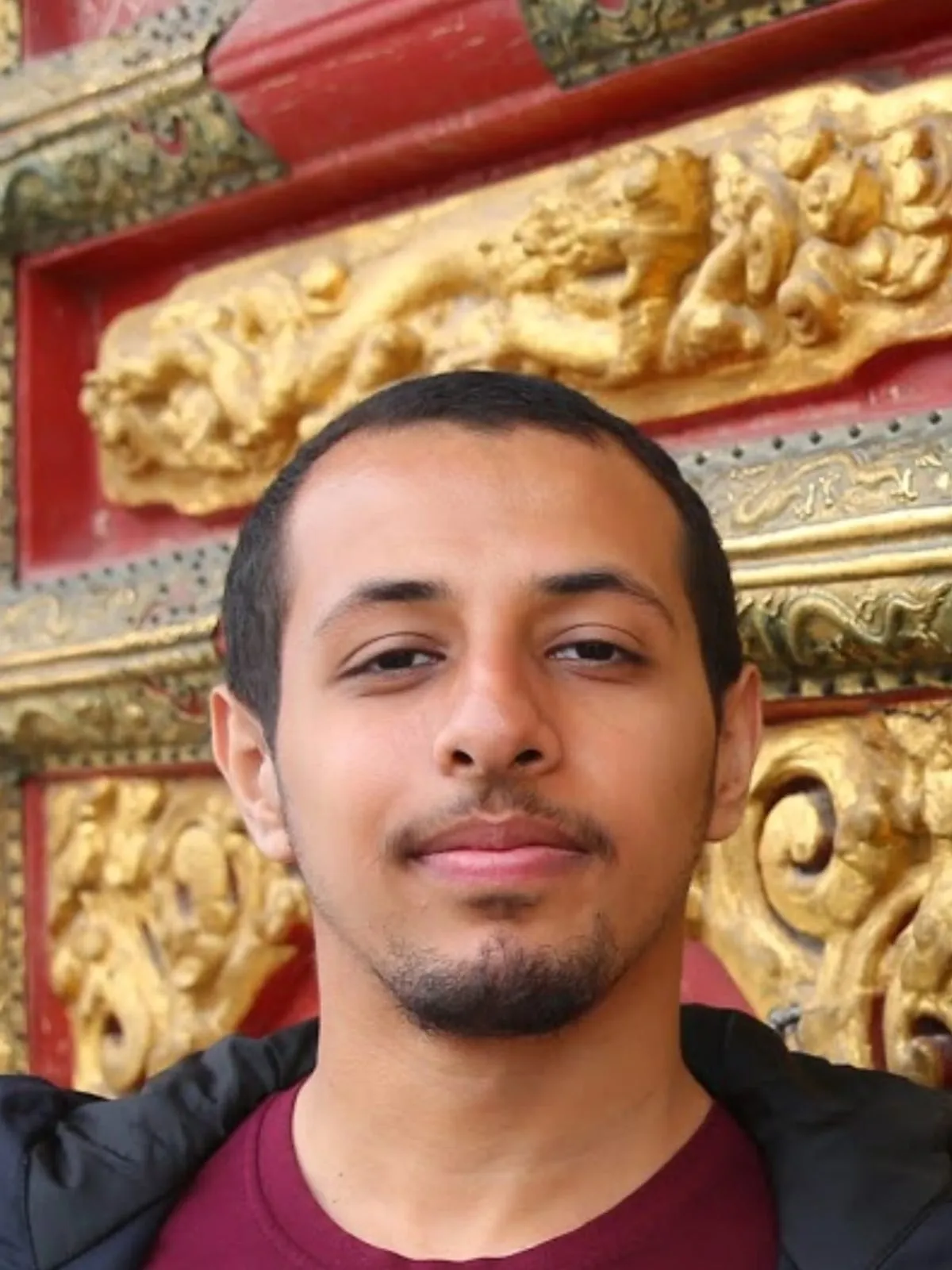
Mohamed Alborati
I'm a solution architect in Brooklyn. I run Alborati LLC, which is a one-person consultancy by design — same person for whatever layer the engagement actually needs, instead of a team you have to onboard every time the scope shifts. I've been doing this long enough that the throughline is obvious to me now even if it took twenty years to spot it: every job I've held has been about operating at the layer the work demanded, and changing layers when it changed.
The arc
I started in electronics retail. Marcy Camera in Brooklyn, ages 14 and up — fixing tape decks, talking to walk-in customers, learning that the difference between "this works" and "this ships" is mostly persistence. Before that, and alongside school, I paid my way by moving furniture and doing fit modeling, and taught STEM to kids ages 4–14 as an educator at Engineering for Kids. Range and grit: both came early.
CUNY came next — a B.Tech in Computer Engineering Technology and an A.A.S. in Mechanical Engineering Technology, CUNY — New York City College of Technology, plus a research stint co-authoring peer-reviewed computer vision for robotics work with Prof. Lili Ma at CUNY City Tech: onboard vision on VEX platforms (IEEE 2018), visual servoing in undergraduate robotics (IEEE 2019), multi-robot wireless coordination (IEEE 2019), and camera-calibrated localization for mobile robots — published as a journal paper in the International Journal of Computational Vision and Robotics (Inderscience, 2022). Two disciplines, two degree types, and a research line that spans conference work through a peer-reviewed journal: the academic and cross-domain base that the later regulated work relied on.
NPower Tech Service Corps came after that — fifteen weeks of full-stack training built specifically to land working-class New Yorkers in real engineering jobs. I went in as a kid who could solder and came out with a placement and a clearer sense of what the work could be.
NPower placed me into an internship at NYU's Governance Lab, on Re:coded — a tech-education initiative for people displaced by conflict, working with UNHCR. First time I saw software aimed at people whose stakes were existential, not commercial. It set the bar for what "the app has to work" means.
Then Scripps Networks — but as a product manager, not an engineer. I owned the Food.com login flow: the least glamorous, most consequential screen in any product, the one every single user hits. Learning to own an outcome instead of a ticket is a different muscle, and it's the one that makes the architecture work later.
Cognizant came next, embedded with Discover Financial as a QA Lead. Quality at a financial institution isn't "find the bugs" — it's "prove the thing is correct before it touches someone's money." That discipline is the spine of the regulated work I'd do later.
At Wipro I was placed on the DISH Network engagement in Denver. Two big builds came out of that year: the OTA Signal Meter app, which paired with a Bluetooth hardware device and gave the technical artifact that enabled a major carrier deal; and the MyDISH modernization, which took a 1M+ user Android app from Java + on-prem to Kotlin + AWS. I led the offshore side, then helped reorganize the engineering teams into a BAU track and a New Tech track — that was the first time I did organizational work in addition to engineering work, and I learned I liked it.
After Wipro I moved to AgreeYa, contracted to Deloitte's engagement with Eli Lilly on the Tempo connected diabetes platform — a Class II Software as a Medical Device — a connected diabetes platform that received FDA 510(k) clearance in 2022 and CE marking the same year. I led the Android architecture, managed an offshore team of 10+ across a 24-hour development cycle, delivered the documentation that supported regulatory clearance, and built a Kotlin Multi-Platform proof-of-concept that cut development time on later features by more than two months.
Then Wayfair — Senior Android Engineer, started as a contract engagement through Alborati LLC, converted to full-time within months. Built the Wayfair Financing integration on Android with the major BNPL lenders, then led the Android side of the Wayfair Rewards launch in October 2024 — the $29/year paid loyalty program covering five Wayfair brands. Won seven internal recognition awards in the first year. Still there, now Android Lead on Loyalty & Financing.
Underneath all of that, TeddyMozart — a Brooklyn smart-toy startup I co-founded in 2016. Bluetooth-connected teddy bear paired with a mobile app. Forbes 2016 connected toys gift guide. QVC. It's still on shelves a decade later. The arc starts there in some ways — TeddyMozart was the first time I worked at every layer simultaneously, on a real product, with real consequences.
Alborati LLC is the synthesis of all of it. One person. Every layer. By design.
Career timeline
Foundation years are grouped intentionally — the exact sequence mattered less than the disciplines each one added.
- Foundations (before 2019) — CUNY City Tech (B.Tech Computer Engineering Technology + A.A.S. Mechanical Engineering Technology) · NPower Tech Service Corps · NYU Governance Lab / Re:coded / UNHCR (via NPower) · Scripps Networks — Product Manager, Food.com login flow · Cognizant — QA Lead, embedded with Discover Financial
- 2016–2019 — TeddyMozart — Technical Co-founder
- 2019–2020 — Wipro, embedded with DISH Network — Mobile Tech Lead (OTA Signal Meter + MyDISH)
- 2020–2021 — AgreeYa → Deloitte, with Eli Lilly — Android Lead / Architect (Tempo, Class II SaMD)
- 2019–present — Santa Clara University / Incident Aid — Volunteer technical advisor
- 2021–present — Alborati LLC → Wayfair — Senior Android Engineer → Android Lead (Loyalty & Financing)
How I work
These are the five things I keep coming back to. They're not values posters — they're decisions I've had to defend in rooms where they cost something.
"Specs are a starting point, not a contract."
The spec is your best guess at the right answer at the moment it was written. The work is the act of finding out where the spec is wrong. The mark of a senior engineer isn't following the spec — it's noticing when the spec is wrong and saying so before the team builds something everyone has to throw away.
"Shipping is the only acceptable outcome."
Demos are not deliverables. Slideware is not architecture. The only thing that counts is software in front of users, paying for itself in some way the business can measure.
"If I can't explain a decision to a non-engineer, the decision isn't right yet."
This is the lesson the regulated-industry work taught me. The FDA-clearance work needed documentation that survived auditors who weren't engineers. The Wayfair Rewards work needed a Loyalty PM and a Brand director and Legal to all see the same product. If the decision can't be made legible across that surface, it's not done.
"Most regulated-industry pain is documentation pain, not engineering pain."
The hard part of Class II SaMD wasn't the architecture. The hard part was the audit trail — proving every decision was traceable to a requirement and every requirement was traceable to a clinical need. Teams that haven't worked under regulators underestimate this by an order of magnitude.
"Senior judgement is a thing you can rent. Buy it from someone who has it."
You don't have to hire a CTO to get one good architectural decision. You don't have to staff a five-person mobile team to ship a mobile app. The whole point of a fractional senior is that the judgement is the asset; the hours are the carrier.
Recommendations
“I had the pleasure of managing Mo for the past year. He has made a significant impact by leading a few key initiatives during his short time like Wayfair Financing on Android. He demonstrated his Android knowledge, his ability to collaborate his stakeholders, and his care for his team during this timeframe. He has grown to become a key contributor in team Loyalty And Financing App in this short timeframe.”
“I worked with Mo on developing leading edge digital health solutions. As a technical lead on our Android platform, Mo demonstrated deep technical expertise and forward-thinking architecture strategy. Mo showed exceptional range in his ability to be deeply technical while simultaneously being able to clearly communicate functional and business impacts to non-technical stakeholders. As a teammate, Mo was flexible to changing needs and requirements and had the ability to step in wherever his team needed the most help. I would always go to Mo for challenging technical roles.”
“Mohamed Alborati, shortly 'Mo' is one of the very rare candidate/colleague/friend whom you will like to work with by your side in your team. He is an exceptional fellow with a quick grasping capacity of the problems. Given a problem he analyzes it from multiple perspectives and comes up with multiple solutions and discusses with the stake holders and determines the best solution based on the need. … He was so instrumental in many of our new emerging tech projects in cloud and modern hybrid frontend platforms in mobile and web. He was our one stop shop for solution design expertise. Some of his key areas of expertise include AWS cloud (Especially the modern serverless architecture components like cognito, lambda, appsync, api gateway, dynamodb, cloudwatch, cloudfront, WAF, etc), react, react native, node, python. Overall, he is one of the candidates whom you will feel comfortable to work with and delegating a responsibility to him means that the project can be considered as done. He will take care of end to end delivery.”
“I have known Mo Alborati for five years. His remarkable growth as a professional over this time period has impressed me. His superior intellect, positive temperament and cool demeanor have removed all obstacles in his progress and maintained his focus in attaining his goals. I also appreciate him for his integrity and his work on social causes.”
“Apart from our mentorship engagement, I, as an Advisor at Teddy Mozart have worked with Mo who is a Co-Founder of this start-up. I have witnessed his quick adaptation of the best-suited technology, and implementation of the business app both for Android and Apple devices. He has managed the schedule and planned the releases of the product very well. His stakeholder and investor communications have also matched the demands of the start-up.”
Recognition
- 2019 · Residential Systems Magazine — Best of Show, CEDIA Expo (DISH OTA Signal Meter)
- 2019 · Wipro — Victory League Award
- 2022–present · Wayfair — seven internal recognition awards across two company-wide categories
- 2016 · Forbes — featured in The Best Connected Toys: A 2016 Gift Guide (TeddyMozart)
- 2022 · Int. J. Computational Vision and Robotics — co-author (with Prof. Lili Ma, CUNY City Tech), Ground landmark-based localisation for mobile robots using a calibrated camera
- 2018 · IEEE ICEED — co-author (with Prof. Lili Ma, CUNY City Tech), Enhancement of a VEX Robot with an Onboard Vision System
- 2019 · IEEE ICEED — co-author (with Prof. Lili Ma, CUNY City Tech), Wireless Inter-Vehicle Communication Among VEX Robots
- 2019 · IEEE ICEED — co-author (with Prof. Lili Ma, CUNY City Tech), Inclusion of a Visual Servoing Project into an Undergraduate Robotic Course
- 2018 · ASEE NE — IoT in Myo-Prosthetics
- 2016 · New York Founder Institute — graduate (TeddyMozart)
- Education · B.Tech in Computer Engineering Technology + A.A.S. in Mechanical Engineering Technology, CUNY — New York City College of Technology
Outside the work
Incident Aid + SCU + California firefighters
2019 – present
Six-plus years of volunteer technical advising. I've worked with students and staff at Santa Clara University on mobile applications used by California firefighters — and stayed in direct collaboration with the firefighters themselves.
Full case study →Greenpoint Islamic Center
2008 – 2011
Managed the Sunday school program for three years. The first leadership work I did. It taught me a different version of "ship it" — the program ran every Sunday, on time, with the kids who showed up, regardless of whether I'd slept.
What I'm not
I'm not the right person if the project is a marketing website, a logo, a Shopify storefront, or anything a smart non-engineer could build on a no-code platform in a weekend. I'm not a generalist freelancer — I'm a senior solution architect, and the engagement should need senior judgement to justify the cost. I'm also not an agency — the work is me, not a team, not a bench of subcontractors, not an offshore arm. If you need a team, I can help you build one, but I won't pretend I am one.
The full Worth Hiring / Not Worth Hiring breakdown lives on /services.